Image Slider 1 - Bonsai
Healing Naturally with Acupuncture, Herbs & Massage
Philadelphia’s Most-Trusted Acupuncture Clinic
previous arrowprevious arrow
next arrownext arrow
Image Slider 1 - Bonsai
Healing Naturally with Acupuncture, Herbs & Massage
Philadelphia’s Most-Trusted Acupuncture Clinic
previous arrowprevious arrow
next arrownext arrow

By Mind-Body Guest Blogger & Herbalist, Julie Wise

Before seriously exploring herbalism and TCM, I had this idea that medical care was something that I passively experienced, something that happens to me. When I began to meet more acupuncturists, Doctors of Traditional Chinese Medicine, and clinical herbalists, I noticed that we had a different relationship than the typical allopathic doctor/ patient dynamic. The symptoms and stories I shared seemed to carry more weight; practitioners were invested in every word I was using and how I related to my body and energy.

In my old reference book of homeopathic materia medica (that I refer to more out of novel curiosity rather than necessity), the diagnostic semantics are notably focused on the complex, sometimes hard-to-describe lived experience of the patient. Some of my favorite examples are these three descriptions of vertigo, among many: “vertigo; sensation of air or wind passing through head,” or “vertigo; sensation of head being stirred by a wooden spoon”, or “vertigo; walls of house seem to be falling in.” Or, take these instances of different sensations of coughing: “coughing; overpowering, as if larynx were tickled by a feather in the evening before sleep”; “coughing; aggravated by reading aloud”; “coughing; touching the canal of the ear.” These eccentric medical descriptions may seem completely redundant to some, but their specificity implies that only certain readers or patients will really understand the lived experience of that symptom. I was fascinated when I first found this book because the attention to detail in personal experience felt unfamiliar, like it had been missing from most of my allopathic medical treatments up to that point.

Similarly, I recently had an intake appointment with a new acupuncturist. After explaining my symptoms, focusing on my periodic episodes of tachycardia (racing heart), she left the room for a moment, then asked me this: “Does your heart ever feel empty or hollow, like it’s been scooped out?” I couldn’t help but laugh a bit. I would never think to describe my bodily experience in that way, but yes, that’s exactly what my heart felt like sometimes! She nodded and wrote some notes down. I was giddy with the feeling of being thoroughly understood by my clinician. Like my slightly antiquated leatherbound homeopathy book, Traditional Chinese Medicine and acupuncture give space for this kind of detail in fascinating and refreshing ways. This is certainly not a claim that acupuncturists are the only kind of medical practitioners with this keen attention to patient experience, but rather an ongoing observation that the specificity of inquiry from TCM practitioners towards patients often results in new insight.

Our bodies are unimaginably complex, and further understanding seems to only put forward more questions and more complexity. I’ve witnessed all kinds of TCM practitioners embody this detail-oriented curiosity, and they seem to acknowledge (and enjoy, perhaps) this complexity by engaging the patient on an equally complex, or thorough, scale. Opening up to that degree of inquiry results not only in effective treatment, but also better understanding of the intricacy existing within each of us.

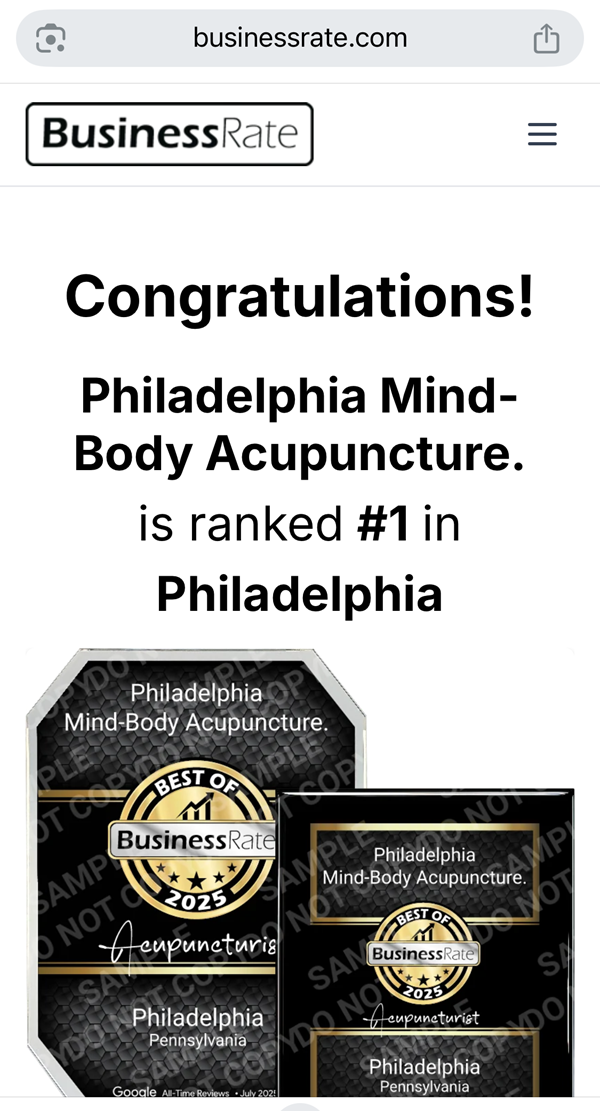
Based on all-time reviews and other factors, BusinessRate.com ranked Philly Mind-Body Acupuncture #1 in Philadelphia.

Number one in Philadelphia

Philadelphia Mind-Body Acupuncture has WON the Happenings Media (Philadelphia area) ‘Sports Medicine’ category 3 times between 2018 and 2025 and has been in the top 2-3 in the remaining years during that span.

Additionally, Philly Mind-Body Acupuncture has frequently been a ‘Finalist’ or in the top 3-4 clinics in the Happenings Media ‘Acupuncture’ category over the past 9 years.

Even more impressive, Philly Mind-Body Acupuncture is the ONLY Philadelphia clinic to frequently get  nominated into BOTH the Sports Medicine category as well the Acupuncture category.

2018
Acupuncture Category:  Nominated:  4th Overall
Sports Medicine Category: Finalist:  3rd Overall
2019
Acupuncture Category:  Nominated:  4th Overall
Sports Medicine Category: Finalist:  3rd Overall
2020
Acupuncture Category:  Finalist:  2nd Overall
Sports Medicine Category: WINNER!!!!
2021
Acupuncture Category:  Nominated:  4th Overall
Sports Medicine Category: WINNER!!!!
2022
Acupuncture Category:  Nominated:  4th Overall
Sports Medicine Category: Finalist:  3rd Overall
2023
Acupuncture Category:   not Nominated
Sports Medicine Category: Finalist:  3rd Overall
2024
Acupuncture Category:  not Nominated
Sports Medicine Category:  WINNER!!!!
2025
Acupuncture Category:   not Nominated
Sports Medicine Category: Finalist:  2nd Overall
2026—- Results will be revealed Feb 28 2026
Acupuncture Category:   Nominated:  Results__________?
Sports Medicine Category:  Nominated:  Results__________?

The Doctrine of Signatures (DoS) is a theory in herbalism practice asserting that the physical characteristics of a plant describe its healing capacities and targets within the body. For example, mullein (Verbascum thapsus) has broad leaves covered in a thin layer of soft hairs, closely resembling the shape and cilia-covered nature of the lungs; mullein is commonly used to treat lung and respiratory ailments. 

When I first learned about the DoS, I was unsure how to relate to the theory. It felt at odds with the ways I had learned to relate to medicine and the role of a patient in medical treatment. But when I began to see the Doctrine of Signatures not as a fixed truth but rather as a pedagogical tool to get to know the plants around me, I was able to really deepen my connection to herbalism and appreciate the healing power of relationships with our plant allies. 

I first began studying herbalism a few years ago, as an apprentice at a school in Massachusetts. I instantly felt that relating to plants around me was an entirely different experience from the way I’d previously engaged with medicine. It almost seemed like the herbal medicinal was the true actor in relation with the patient rather than the prescribing herbalist. 

While it might be easy to say that the theoretical framework of Traditional Chinese Medicine (TCM) and herbal medicine are inherently at odds with “modern” or allopathic Western medicine, I find that things are in fact more complex: engaging with herbs as a treatment modality is a relational practice that necessitates close observation and curiosity in ways that facilitate healing and care.   This can be an excellent complement to any kind of medical treatment, from allopathic to TCM and beyond.

 During my summer working at the herbalism school, I spent my days organizing herbs and preparing medicine in the apothecary. Every morning, the school’s director and I would go on a “weed walk,” where she would help me properly identify every plant in her expansive garden. With my Newcomb’s Wildflower Guide book in hand, I would use all of the skills she taught me for identification: leaf shape and placement, number of flower petals, size, smell, texture, taste, et cetera. By the end of my time with the school, I had developed a deep comfort and understanding within this garden, and I felt more comfortable preparing medicine with these plants as a result. 

Yes, I indeed referred to the Doctrine of Signatures throughout my identification processes (“I am noticing evenly spaced and alternating leaves, much like the vertebrae of a spine; this must be Solomon’s Seal, and the structure reminds me that this plant is used for healing joint issues.”).  But the DoS was a pedagogical mnemonic tool more than it was objective truth. 

Similarly, anthropologist and herbalist Charis Boke says that “the doctrine of signatures is used as a mode of knowledge that involves cultivating an attentive, friendly relation between herbalist and plant – not as a primary way of determining the medicinal capacities of plants”. As I began to really embody these “friendly relations,” it felt easier to invite their healing capacities into my mind and body. 

Nowadays, when I am prescribed herbs from Phila Mind-Body Acupuncture or from another herbalist, I take it as an opportunity to engage with, to get to know, these plants as much more than an inanimate prescription. The qualities of plants can be legible to us, and perhaps there is medicine in the very relationship itself.  


This article was written by Guest Blogger, Julie Wise.  

Julie is an herbalist and farmer from Massachusetts, who helps us at Philadelphia Mind-Body Acupuncture with important tasks from time to time.  Julie plans to pursue a career as an Acupuncturist-Herbalist and will likely start TCM school in Fall 2026.

Health and Wellness assessment of Philadelphia acupuncture clinics by author Pamela Toy – read post here.

A growing body of Randomized Controlled Trials (RCTs) continues to prove that the millennia-old practice of acupuncture can be an effective treatment for numerous conditions and illnesses.  Because of a burgeoning interest in acupuncture research among some of the world’s top medical research centers such as Stanford, Harvard, UCSF, etc, it has become known that acupuncture does work.  The question, however, remains how?

Acupuncture has been shown to create various physiological and biological changes in the body on numerous levels simultaneously, therefore, mapping out its systemic effect on the mind-body is quite a complex process.  It is a common belief that the concept of energetic channels within the body (meridians), which convey and transport subtle bodily mechanisms thoughout was developed thousands of years ago by sages and ascetics who could feel these subtle processes within their own bodies.

Acupuncture points, in general, were considered way stations along these energetic highways (meridians) where Qi or energy congregated or pooled in larger quantity in relation to other places along the meridians (places along the meridians where no points were designated).  Generally-speaking, these places where Qi tends to pool along a meridian (acu-points) are considered more therapeutic than non-Qi-pooling places.

In my humble opinion, modern science is not yet quite sophisticated enough to detect the subtle systemic changes toward health and homeostasis that acupuncture can produce.  To really map out all of the changes produced by one acupuncture session, for instance, modern science would need to invent a machine that can somehow monitor physiological and biological changes within the body for an extended period of time.  A diagnostic device like this- if ever produced- might look like a wear-able functional MRI (fMRI) machine that also can monitor subtle biological and physiological changes such as changes in inflammation levels, hormone and endorphin levels, immune response, etc.

Mapping these physiological changes has started to happen to an extent with Dr. Sean Mackey’s work at Stanford University, using functional MRI (fMRI) machines in conjunction with acupuncture.  However, despite illuminating the fact that physiological and brain activity in the body does occur with the insertion of acupuncture needles, even this type of research does not clearly display how acupuncture works in a simplified way.  This is, in my opinion, the conundrum. It is, seemingly, still too complex to map out as acupuncture creates changes on multiple levels simultaneously.

Despite this complexity, when patients, friends or colleagues ask, I do still often try to explain some of the ways in which acupuncture can effect change within the mind-body continuum.   There are a number of modern theories that explain ways in which acupuncture is thought to effect positive change towards health in humans and animals (vertebrates).

To explain this, I’ve found a helpful article by Netherlands-based acupuncturist, Johanna Biemans, which can be found online here:  https://www.linkedin.com/pulse/top-5-theories-explained-how-acupuncture-works-johanna-biemans/

The following is from acupuncturist Johanna Biemans’ article, ‘Top 5 Theories That Explained How Acupuncture Works‘:

1. Endogenous endorphin release

The all time number one when it comes to explaining how acupuncture could influence our bodies is the triggering of the endogenous endorphin release. Endorphins are our bodies own painkillers and are produced in the midbrain. Bruce Pomeranz was the first to describe the relation between acupuncture and the painstilling effect due to endorphin release. He specifically draw attention to the delay time of 20 min. between stimulation and the onset of the analgesic effect. The time necessary for processing the endorphin from the precursor pro-opiomelanocortin (POMC). The endorphins involved are most likely beta-endorphin.  

2. Triggerpoint deactivation

A definite second place belongs to the popular triggerpoint theory (our bodies expression of pain by hypersensitive knots in striated muscles).  Unlike the endorphin theory, this theory has caused a lot of debate amongst acupuncturists and the so called dry needling therapists about ownership. Basically acupuncturists are familiar with treating painspots or “Ashi”points as it is defined in the original theory. Deactivation of myofascial triggerpoints resolves stifness and pain. This can be achieved by specific needling techniques.

3. Modulation of nerve activity

In third place I chose neuromodulation: acting upon nerves to alter nerve activity. Neuromodulation is a fast growing field and when we consider the therapeutic impact that came along with it. this theory deserves a place in the Top 5. Some of the modalities are originated or closely related to acupuncture. The explanation holds that needling in the close surroundings of mostly peripheral nerves, effects can be evoked at a spinal or supraspinal level. This antidromic stimulation presumably has a modulating effect through a segmental way on organs or body functions. The most known are stimulation of n.medianus in cases of PONV ( Postoperative Nausea and vomiting) and n. tibialis posterior stimulation (PTNS) in the treatment of pelvic disorders. Discussion continues about the frequencies, intensities and duration of stimulation. Because manual needling requires a very precise craft these kind of stimulations are mostly performed with electrical devices: electroacupuncture. Very, very speculative  but worth mentioning is the riddle of “Bagdad’s Batteries”. On a site near Bagdad Archeologists found battery like objects. And in close surroundings some needle like objects. One theory states that they might have been used for electrostimulation according to acupuncture principles.

4. Counterstimulation at spinal level

From the fourth place on choosing becomes harder. If I take into account: “times cited in literature” I guess counteracting deserves a place in the Top 5. Many times in a negative connotation though. Acupuncture is no more than counterstimulation. Counterstimulation is based on the wellknown gate control theory of Melzack and Wall.  Different stimuli from the periphery can inhibit each other at spinal level and thus painful stimuli can be suppressed.

5. Increase of blood flow.

At fifth place I firstly selected ‘balancing the autonomous nerve system” which is frequently quoted. But then I realised that this mode of action comes very close to the ones (3 en 4) mentioned above. And merely is a different angle of referring to similar mechanisms. I considered influencing ‘hormonal balance’ or ‘immune functions’. Then of course I came up with the mostly local effect of increasing the blood flow. The puncturing of soft tissues and muscles brings forward a production of adenosine which binds to the ephitelium of bloodvessels and induces the release of nitrooxygen which causes a vasodilatation of the bloodvessel. It’s usage preferred in local ischaemic conditions.

The most close explanation of acupuncture is likely a combination of mechanisms plus the missing link that is expressed in it’s original concepts.

Related article:

http://cim.ucsd.edu/clinical-care/acupuncture.shtml

Dr. Aaron Cashman
Dr. Aaron Cashman
Licensed Acupuncturist & Herbalist
(DAOM, L.OM., M.S., DiplOM, CYT)
line